
‘Lead right now, not some day’ – Webinar showcases growing power of youth leadership across SYCP network
Young people are not simply the leaders of tomorrow; they are already leading today – and sport can provide the space, trust and opportunity they need to make a difference.
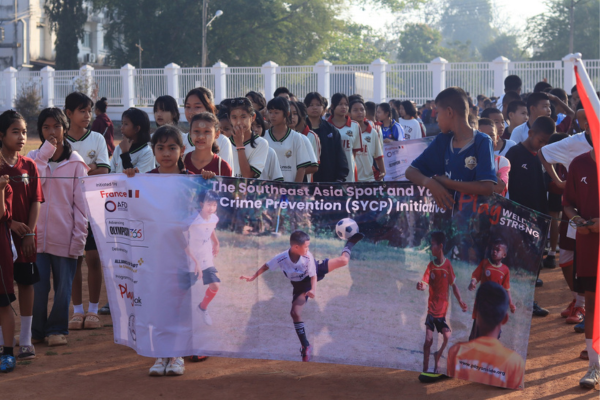
That was the message from a recent webinar organised as part of the Southeast Asia Sport and Youth Crime Prevention (SYCP) Initiative, bringing together more than 90 participants from across the global sport for development community to mark International Youth Day and ASEAN Youth Day.
OPPORTUNITIES
The SYCP Initiative was initiated by the International Olympic Committee (IOC) and Agence Française de développement (AFD), and is delivered by the Alliance of Sport in Criminal Justice in collaboration with Laureus Sport for Good, Upshot and partners across Southeast Asia.
Opening the webinar, Susanne Gaerte, IOC Senior Manager for Olympism365, highlighted the challenges facing young people, including inequality, exclusion, violence and limited opportunities.
“Yet they share common aspirations to belong, to contribute, to be heard, and to build a better future,” she said, describing sport as a powerful way to build confidence, resilience and leadership, particularly for young people from underserved communities.

The IOC’s new Fit for the Future strategic framework places participation, equality and inclusion, and transferable skills at the heart of its ambition to transform lives through sport.
Susanne closed with a clear challenge to policy-makers and practitioners: “Let us create more spaces for young people not only to participate but to lead. Let them be at the table where decisions are made.”
That principle is already becoming reality through the work of Tania Lee (pictured above), an IOC Young Leader from Malaysia.
LEADERS
Her ‘I Lead’ programme gives young athletes with and without disabilities opportunities to develop sport values, healthy living, life skills and social competence. Delivered through the Malaysian Olympism in Action Society since 2021, it has already supported more than 100 young leaders.
Tania also highlighted how sport can contribute to prevention by responding to issues such as bullying, exclusion and social isolation.
“We want to give them some opportunities and exposure,” she said. “Sometimes they may have done something not right, or they have not been accepted by society, but nobody was there for them. So we hope to be able to give them this support.”
She explained that sport creates an environment where positive change can happen more quickly.
“Sports people are usually goal-oriented, they are driven, they have the resilience. For us to reach out and touch your heart, it is also easier.”
The webinar also heard from Joel Atienza, Senior Officer for Education, Youth and Sports at the ASEAN Secretariat, who set out the scale of the opportunity facing the region.
DIVIDEND
With around 213 million young people aged 15 to 34 across ASEAN nations – roughly one-third of the population – he described this as a “time-bound dividend” that must be maximised.
“If we have this demographic window, then we have a very strong young workforce that lifts our productivity.”
To unlock that potential, he argued, education, health and employment must keep pace while ensuring young people feel included and connected. He added: “We cannot ignore these challenges being faced by our young people.”

The final speaker, 17-year-old Nathalie Parrenas (pictured above, speaking on the webinar), a coach with the Philippines Rugby Union’s Pass It Back programme in Olongapo, brought the conversation back to lived experience.
Supported through the SYCP Initiative, the programme gave her responsibility as a coach while she was still a teenager – transforming her confidence and enabling her to support others.
“I realised I could teach sport even if I wasn’t sporty by nature, because Pass It Back is never just about the sports. It focuses on how you lead your community and how you share and teach life skills.”
SUPPORTED
Her experience also showed the power of youth-led inclusion. When a participant faced discrimination because of her identity, Nathalie stepped in to create a space where she felt accepted and supported.
“That’s the quiet power of sport-based leadership. It doesn’t just build better athletes; it builds people whose default is to look out for each other.”
The webinar’s central message was clear: prevention should be youth-powered, inclusive and rooted in positive opportunities. Sport creates belonging, develops life skills, builds trusted relationships and gives young people meaningful responsibility.
“That is what International Youth Day and ASEAN Youth Day mean to me,” said Nathalie, in closing. “They are not just about celebrating young people; they are a reminder that young people are already leading. They are not ‘future leaders’, they are leaders today on the field, in our schools and in our communities.”
Read more about the Southeast Asia Sport and Youth Crime Prevention (SYCP) Initiative.